
Be Wary of Enthusiastic Endorsers Who Are Not Experts: Why Proper BFR Cuff Placement Matters
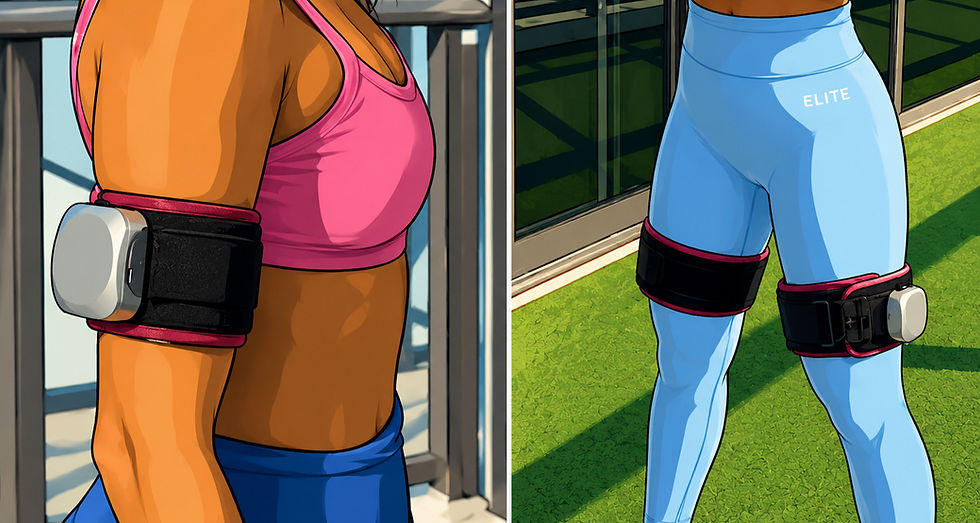
If you don't know what's wrong with these images, you do not know enough about blood flow restriction training (BFRT) to either use it correctly or worse, instruct others!
I recently saw a social post by an influencer that popped up as an ad. The images above were captured from video then cropped, colors changed and rendered as an animation because this post is not about the influencer or the brand.
Don't get me wrong, it’s great to see online influencers getting excited about blood flow restriction training (BFRT) and sharing the real benefits it can deliver — faster recovery, strength gains with lighter loads, and joint-friendly training.
What’s not great? When that enthusiasm is paired with improper instruction such as cuff placement. Improper cuff placement can make the experience painful, ineffective, and limit movement, it can also be unsafe.
Take the example in the above image. While the influencer does a solid job explaining some of the benefits, both the upper and lower body cuffs are placed incorrectly.
The upper body cuffs are positioned directly over the biceps. Correct placement is much higher — high in the armpit, proximal to the humeral head. This is the anatomically safest and most effective spot.
The lower body cuffs are also placed too low. Correct placement is high in the groin, proximal to the femoral head. Same reason as above.
These are not minor details and there is no evidence that the placements shown above will provide safe, optimal results. In fact, in a couple of studies, where the cuff was installed close to the elbow or knee, the author questions the efficacy of BFR.
Proper proximal placement is one of the most important factors for safe, comfortable, and effective BFR training.
The Hard & Simple Rule (No Matter Which Brand Cuff You Use):
Upper body: High in the armpit, right next to the shoulder (proximal to the humeral head).
Lower body: High in the groin, right next to the hip (proximal to the femoral head).
The image below shows where BFR cuffs should be installed.

There are clear anatomical and physiological reasons for the proper locations. Plus, placing cuffs too low restricts movement and results in pain, reduced effectiveness, and higher risk.
This is exactly why we’re so intentional at RockCuff about education. Improper technique is one of the biggest reasons people abandon BFR training or develop a negative view of it. When people experience pain or poor results, they blame the method instead of the execution.
I occasionally see our own enthusiastic users make similar mistakes in their excitement so we are not immune.
When we catch it, we reach out immediately with correction and guidance — because safety and results always come first no matter how many sales we get from the endorsement.
Bottom line: Be careful whose demonstrations you follow. More important, before you demonstrate or instruct others, be sure you know what’s right! Real expertise matters.
Proper placement turns BFR from something uncomfortable and questionable into a simple, safe, and powerful tool for better training and faster recovery.
Call to Action: Want to learn how to use BFR cuffs the right way? Download our free Proper Cuff Placement Guide or check out our evidence-based, equipment-agnostic training resources at RockCuff.com.


Comments