
Research and Evidence
An annotated reference list for blood flow restriction (BFR) training, grouped by topic. Every study links to its DOI or PubMed record. RockCuff's own test records are in a labeled section at the end.
Written by: [AUTHOR] · Clinically reviewed by: [CLINICAL REVIEWER] · Last reviewed: [DATE]
Definitions
BFR training: exercise with a cuff high on the arm or thigh that fully restricts venous outflow while arterial inflow continues (Patterson et al., 2019).
AOP / LOP: arterial or limb occlusion pressure, the cuff pressure at which arterial inflow stops, measured with a given cuff in a given position. Studies report BFR pressure as a percentage of it.
Effective width: the share of a cuff's stated width that actually presses on the limb.
Meta-analysis / umbrella review: a study pooling the results of many trials / a review pooling many meta-analyses.
More terms: BFR Glossary [LINK WHEN PAGE BUILT].
Jump to: History · How BFR works · Venous occlusion · The pressure range · Pressure is an estimate · Cuff design · Safety · Strength · Rehab · Aerobic · Older adults · Military · RockCuff test records
History: From Japan to Clinical BFR
Light exercise with a cuff sent growth hormone about 290 times above resting levels.
Backed by: Takarada Y et al. (2000), J Appl Physiol
Older women lifting light weights with a cuff grew as much muscle and strength as with heavy weights.
Backed by: Takarada Y et al. (2000), J Appl Physiol
No exercise needed: cuff pressure alone cut post-surgery thigh-muscle loss by more than half (9.4% vs 20.7%).
Backed by: Takarada Y et al. (2000), Med Sci Sports Exerc
Elite rugby players got bigger, stronger and more enduring legs from light, cuffed training. The same light training without a cuff produced no significant gains.
Backed by: Takarada Y et al. (2002), Eur J Appl Physiol
Just walking with cuffs built 4–7% more thigh muscle and 8–10% more strength in 3 weeks.
Backed by: Abe T et al. (2006), J Appl Physiol
The first clinical BFR rehab trial: after ACL reconstruction, light cuffed training beat the same rehab without a cuff for strength and muscle size.
Backed by: Ohta H et al. (2003), Acta Orthop Scand
By 2015, a growing body of evidence backed light loads plus moderate restriction for muscle growth and strength.
Backed by: Scott BR et al. (2015), Sports Med
BFR has grown well beyond the weight room. Passive, aerobic, high-load and sport-specific methods are now in use.
Backed by: Scott BR et al. (2023), Int J Sports Physiol Perform
How BFR Works
BFR adds metabolic stress to mechanical tension, the two primary drivers of muscle growth.
Backed by: Pearson SJ et al. (2015), Sports Med
A cuff significantly increased metabolic stress inside the muscle during light exercise.
Backed by: Suga T et al. (2009), J Appl Physiol
Measurable muscle growth in 2 weeks, and the more metabolic stress, the more growth (r = 0.876).
Backed by: Takada S et al. (2012), J Appl Physiol
One light BFR session raised muscle protein synthesis 42% at 3 hours and 69% at 24 hours through the mTOR pathway.
Backed by: Gundermann DM et al. (2014), Am J Physiol Endocrinol Metab
BFR at light loads matched heavy training for strength (+40.1% vs +36.2%) and muscle size, and cut myostatin, a muscle-growth brake, by 45%.
Backed by: Laurentino GC et al. (2012), Med Sci Sports Exerc
Within 1 hour, light BFR exercise switched on muscle-building signals that the same exercise without a cuff did not.
Backed by: Wernbom M et al. (2013), Eur J Appl Physiol
Light cuffed lifting at 30% of max quadrupled growth hormone. Moderate lifting at 70% without a cuff didn't significantly change it.
Backed by: Reeves GV et al. (2006), J Appl Physiol
BFR exercise switched on more blood-vessel-growth genes (VEGF, HIF-1α, eNOS) than the same exercise without a cuff.
Backed by: Li S et al. (2022), Front Physiol
Venous Occlusion, Not Arterial
Summary on BFR Science. Design response on BFR Technology.
The international position stand describes BFR as fully restricting venous outflow while only partly restricting arterial inflow, with the cuff affecting venous outflow "more severely".
Backed by: Patterson SD et al. (2019), Front Physiol
Venous return can be blocked at low pressure: in vascular research, a cuff at about 40 mmHg (below diastolic pressure) occludes venous return without affecting arterial inflow.
Backed by: Sena CM et al. (2022), EPMA J; Rein-Hedin E et al. (2024), Clin Transl Sci
After a cuff-only BFR protocol, venous compliance and maximal venous outflow dropped while blood pressure and arterial wave reflection didn't change. The authors concluded it "affects venous but not arterial hemodynamics."
Backed by: Loenneke JP et al. (2013), Clin Physiol Funct Imaging
Higher pressures raised effort and discomfort and cut the work people could do. The authors: lower pressures "may be more appealing and provide a safer and more tolerable stimulus."
Backed by: Mattocks KT et al. (2017), Physiol Behav; Jessee MB et al. (2017), Int J Sports Med
Pushing past arterial occlusion backfires: at 150% of occlusion pressure, trained lifters lost strength (−17 Nm) and power (−33.9 W) compared with a sham.
Backed by: Sallberg R et al. (2026), Appl Physiol Nutr Metab
Even the AIS guidelines, which dose by limb occlusion pressure, tell practitioners to "avoid full arterial occlusion" when using BFR during bed rest.
Backed by: Australian Institute of Sport (AIS) (2021), Australian Institute of Sport
The Pressure Range: Why LOP Isn't the Key Factor
Each study's pressure is given in its own terms.
Over 8 weeks, 40% of arterial occlusion pressure built the same muscle size, strength and endurance as 90%. The authors: "higher relative pressures may not be necessary."
Backed by: Counts BR et al. (2016), Muscle Nerve
50–80% of limb occlusion pressure was the effective range for strength.
Backed by: Das A et al. (2022), Front Physiol
Going from 60% to 80% of limb occlusion pressure added no extra restriction (p = .88).
Backed by: Hornikel B et al. (2023), Int J Exerc Sci
At 60% occlusion, light-load BFR matched standard ACL rehab done at more than twice the load.
Backed by: Erickson LN et al. (2025), Med Sci Sports Exerc
At 80% of LOP, ACL patients reached 57% vs 40% quad strength at 6 weeks.
Backed by: Okoroha KR et al. (2023), Orthop J Sports Med
In military knee-pain rehab, 80% of limb occlusion pressure added nothing over a 20 mmHg cuff.
Backed by: Talbot LA et al. (2023), Mil Med
Fixed pressures worked too: about 200 mmHg for elite rugby players, 160–200 mmHg for older women walking, and a mean peak of 238 mmHg to cut muscle loss after surgery.
Backed by: Takarada Y et al. (2002), Eur J Appl Physiol; Ozaki H et al. (2011), J Gerontol A Biol Sci Med Sci; Takarada Y et al. (2000), Med Sci Sports Exerc
More pressure isn't more muscle. Moderate pressure (around 50% of occlusion) delivers the benefit, and pressures near full arterial occlusion add risk.
Backed by: Loenneke JP et al. (2014), Med Hypotheses
Low cuff pressures (20–40% of occlusion pressure) already change leg blood flow, and the body compensates during the set by different amounts in different people.
Backed by: Mladen SPS et al. (2025), J Appl Physiol
Pressure Is an Estimate

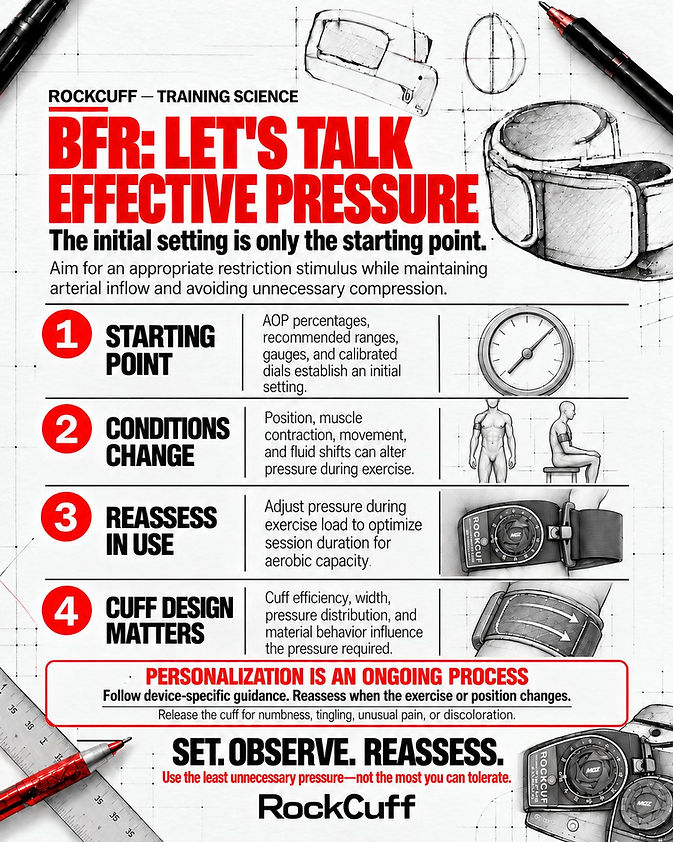
Most BFR studies (56.6%) still pick cuff pressure arbitrarily.
Backed by: Murray J et al. (2021), J Sports Sci
Even "personalized" pressures are mostly unjustified: only 7 of 52 studies explained why they chose their % of occlusion pressure.
Backed by: Clarkson MJ et al. (2020), Scand J Med Sci Sports
Limb occlusion pressure isn't fixed: it jumped from 187 mmHg lying down to 241.5 mmHg standing, so a %LOP measured in one position is off in another.
Backed by: Hughes L et al. (2018), PeerJ
During exercise, a manual-pump cuff ran 48 mmHg above its set pressure on average. The personalized-tourniquet system stayed on target.
Backed by: Hughes L et al. (2018), Scand J Med Sci Sports
The occlusion number moves while you train: it rose after BFR sets, more at higher pressures, and a manual cuff ran 48 mmHg above its set pressure during exercise.
Backed by: Mattocks KT et al. (2017), Physiol Behav; Hughes L et al. (2018), Scand J Med Sci Sports
Pressure that adjusts automatically during exercise beat a fixed set pressure: less effort, discomfort and next-day soreness, and fewer adverse events (1 vs 7 in the fixed protocol).
Backed by: Jacobs E et al. (2023), Br J Sports Med
Cuff Design Changes the Pressure You Need
RockCuff's position: effective width beats stated width. RockCuff's own film test measured how much of each cuff type contacts the limb: 97% for rigid non-pneumatic cuffs vs 49% and 40% for pneumatic designs. See BFR Technology.
The pressure a cuff needs depends on the cuff's design, limb size, sex and race. A one-size pressure doesn't fit everyone.
Backed by: Jessee MB et al. (2016), Sports Med
Same stated width, different construction: two narrow inflatable cuffs, nylon and elastic, occluded the arm at 139 vs 246 mmHg. At 40% of each cuff's own occlusion pressure (57 vs 106 mmHg) the muscle response was the same. Pressure numbers don't transfer between cuffs.
Backed by: Buckner SL et al. (2017), J Physiol Sci
Cuff stiffness changes how tight you need to go. Stiffer elastic cuffs reached the same point at 30.9% overlap vs 54.5% for softer ones.
Backed by: Bielitzki R et al. (2023), BMC Sports Sci Med Rehabil
Across 81 studies, practical (unregulated) BFR gave the same gains in strength, muscle size and function as regulated systems.
Backed by: Clarkson MJ et al. (2024), Clin Rehabil
A simple elastic knee wrap, primed to 60% of occlusion by feel, matched a pneumatic cuff for fatigue, muscle activity and oxygenation, with less cuff discomfort.
Backed by: Bielitzki R et al. (2024), J Sports Sci Med
Simple elastic wraps grew trained lifters' arms as much as heavy training.
Backed by: Lowery RP et al. (2014), Clin Physiol Funct Imaging
Practitioners' BFR methods are all over the map: over half (57.4%) used different cuff widths for upper and lower body, with varying pressures.
Backed by: Patterson SD & Brandner CR (2018), J Sports Sci
Cuff details most people ignore, such as autoregulation, bladder type, shape, and set vs interface pressure, can change the stimulus and safety.
Backed by: Rolnick N et al. (2023), Front Physiol
Safety and Guidelines

The international position stand: BFR builds strength and size with light loads and fights muscle loss when used passively.
Backed by: Patterson SD et al. (2019), Front Physiol
The Australian Institute of Sport sets the safety basics: light loads (20–40% 1RM), time limits and screening. It doses pressure as 40–80% of limb occlusion pressure. See The pressure range.
Backed by: Australian Institute of Sport (AIS) (2021), Australian Institute of Sport
BFR exercise didn't activate blood clotting in healthy adults.
Backed by: Madarame H et al. (2010), Clin Physiol Funct Imaging
BFR raised the body's clot-dissolving activity (tPA +30–40%) without changing clotting markers, and 4 weeks of training didn't affect nerve or vascular function.
Backed by: Clark BC et al. (2011), Scand J Med Sci Sports
In knee rehab trials, BFR patients were no more likely to have an adverse event than patients exercising without it.
Backed by: Minniti MC et al. (2020), Am J Sports Med
BFR training may slightly raise resting systolic blood pressure (+4.2 mmHg), so screening and monitoring are part of every program.
Backed by: Wong V et al. (2022), J Hum Hypertens
A case of rhabdomyolysis after a first BFR session is why every protocol starts conservatively.
Backed by: Tabata S et al. (2016), J Strength Cond Res
A Military Medicine review of 25,813 people: in the right patients, with trained professionals, BFR can be used safely.
Backed by: Anderson KD et al. (2022), Mil Med
Strength and Muscle Growth

47 meta-analyses agree: BFR builds muscle and strength and improves aerobic fitness and vascular health.
Backed by: Oborn C et al. (2025), Sports Med Health Sci
Light BFR training and heavy lifting grew muscle equally, regardless of cuff width or pressure.
Backed by: Lixandrão ME et al. (2018), Sports Med
Light lifting with a cuff beats the same light lifting without one, for both size and strength.
Backed by: Perera E et al. (2022), Clin J Sport Med
For trained lifters, BFR delivered bigger strength and size gains than heavy loads.
Backed by: Geng Y et al. (2024), Sports Med Open
Add a cuff to lifting or cardio and you build more strength and muscle (19 studies, 400 people).
Backed by: Slysz J et al. (2016), J Sci Med Sport
In women, light BFR training matched heavy training for strength, size, fibre type and gene changes.
Backed by: Ellefsen S et al. (2015), Am J Physiol Regul Integr Comp Physiol
Arm cuffs grow your chest and shoulders too, muscles the cuff never touches.
Backed by: Dankel SJ et al. (2016), Sports Med
Light upper-body BFR matched heavy training for chest and shoulder strength.
Backed by: Pavlou K et al. (2023), PLoS One
The 2026 ACSM position stand found BFR grew muscle on par with standard training, and noted most comparisons pit light-load BFR against heavier loads.
Backed by: Currier BS et al. (2026), Med Sci Sports Exerc
Rehabilitation: ACL, Knee Surgery, Tendons and Osteoarthritis
In rehab patients, light BFR training built more strength than light training alone, making it a real clinical rehab tool.
Backed by: Hughes L et al. (2017), Br J Sports Med
After knee surgery, BFR preserved quadriceps muscle better than standard rehab.
Backed by: Wengle L et al. (2022), Am J Sports Med
After ACL reconstruction, light BFR training matched heavy training for strength. It also cut knee pain more (67% vs 39%) and restored more range of motion (78% vs 48%).
Backed by: Hughes L et al. (2019), Sports Med
Less than half the weight, same ACL recovery.
Backed by: Erickson LN et al. (2025), Med Sci Sports Exerc
Stronger, faster: 57% vs 40% quad strength at 6 weeks after ACL surgery.
Backed by: Okoroha KR et al. (2023), Orthop J Sports Med
ACL patients on BFR kept their leg muscle and bone and returned to sport sooner (6.4 vs 8.3 months).
Backed by: Jack RA 2nd et al. (2023), Sports Health
Across 8 trials and 245 ACL patients, BFR improved pain, strength and knee-function scores (IKDC +10.97 points).
Backed by: Gopinatth V et al. (2025), Arthroscopy
After knee arthroscopy, BFR roughly doubled strength gains (74.59% vs 33.5%) with zero adverse events.
Backed by: Tennent DJ et al. (2017), Clin J Sport Med
BFR before knee replacement left patients stronger 3 months after surgery.
Backed by: Jørgensen SL et al. (2024), Scand J Med Sci Sports
Starting the day after knee replacement, passive BFR preserved muscle and reduced swelling. Patients' 6-minute walk improved 23.7%, while the control group's didn't improve (−7.2%).
Backed by: Franz A et al. (2025), J Clin Med
Tennis elbow: real BFR beat sham BFR on pain and function, with 6 times the odds of reporting recovery or major improvement at 6 weeks.
Backed by: Karanasios S et al. (2022), J Orthop Sports Phys Ther
Achilles repair: experts lay out when and how to use BFR to protect calf muscle while the tendon heals.
Backed by: Owens J et al. (2026), Foot Ankle Clin
Knee arthritis: BFR matched heavy training for strength and muscle and improved pain, which heavy training didn't.
Backed by: Ferraz RB et al. (2018), Med Sci Sports Exerc
Across 14 trials and 866 knee-arthritis patients, BFR matched or slightly beat heavy training for pain and strength, with fewer adverse effects.
Backed by: Yang H et al. (2025), Am J Phys Med Rehabil
88.1% of surveyed physical therapists had heard of BFR, but only 38.6% of those had ever used it with a patient. Nearly all who used it (98%) rated it beneficial.
Backed by: Mills N et al. (2021), Res Dir Health Sci
Clinicians who don't use BFR cite a lack of equipment (60.2%), insufficient education (55.7%) and safety concerns (31.8%).
Backed by: Scott BR et al. (2024), J Strength Cond Res
Aerobic and Walking BFR
Two weeks of cuffed walking raised VO2max 11.6% in college basketball players.
Backed by: Park S et al. (2010), Eur J Appl Physiol
15 minutes of easy cuffed cycling built thigh muscle and raised VO2max 6.4%. 45 minutes without a cuff did neither.
Backed by: Abe T et al. (2010), J Sports Sci Med
Cuffed walking and cycling improve aerobic fitness in healthy young adults.
Backed by: Bennett H et al. (2019), J Strength Cond Res
Interval training with cuffs beat intervals alone for VO2max, power, strength and time to fatigue. Cuffs at least 8.23 cm wide were needed for significant VO2max gains.
Backed by: Yin M et al. (2025), J Sport Health Sci
Cardio with cuffs builds more muscle and strength than cardio alone.
Backed by: de Lemos Muller CH et al. (2024), J Strength Cond Res
High-intensity intervals with BFR and low-intensity continuous training with BFR ranked at the top for raising VO2max across 34 studies.
Backed by: Chen H et al. (2026), J Exerc Sci Fit
Elite rowers raised VO2max 9.1% in 5 weeks of low-intensity BFR rowing, vs 2.5% without it.
Backed by: Held S et al. (2020), J Sci Med Sport
Across 10 studies of trained athletes, cardio with BFR improved aerobic capacity from baseline every time, though not significantly more than the same training without cuffs.
Backed by: Castilla-López C et al. (2022), J Exerc Sci Fit
Older Adults and Sarcopenia
Older women grew thigh muscle and gained up to 22% strength just by walking with cuffs.
Backed by: Ozaki H et al. (2011), J Gerontol A Biol Sci Med Sci
In adults over 60, light BFR training grew as much muscle as heavy training.
Backed by: Fabero-Garrido R et al. (2022), J Clin Med
In healthy adults over 60, BFR beat conventional training for strength and matched high-intensity training.
Backed by: Labata-Lezaun N et al. (2022), Arch Phys Med Rehabil
For older adults, cuffs make both light lifting and walking build more strength and muscle.
Backed by: Centner C et al. (2019), Sports Med
Light BFR training boosted muscle-building markers in older adults with no increase in clotting markers.
Backed by: Fabero-Garrido R et al. (2024), Life (Basel)
Blood pressure rises during BFR about as much as with heavy lifting. Within 30 minutes it returns to normal, with systolic pressure below where it started.
Backed by: Zhang T et al. (2022), Int J Environ Res Public Health
In older adults with sarcopenia, light BFR training improved strength, walking and heart-health markers.
Backed by: Zhang M et al. (2024), Sci Rep
BFR improved chair stands (+2.78 reps), the Timed Up-and-Go and knee strength in older adults.
Backed by: Cahalin LP et al. (2022), Front Physiol
Cuffed walking improved older adults' physical function 2.5–4.5 times more than walking alone.
Backed by: Clarkson MJ et al. (2017), J Sci Med Sport
BFR built bone density in older adults as well as heavy training did.
Backed by: Liu Y et al. (2025), Sci Rep
Military and Tactical
Military patients with stubborn limb weakness gained 42–81% in power with low-load BFR after traditional therapy had failed.
Backed by: Hylden C et al. (2015), J Spec Oper Med
The military knee-arthroscopy trial that helped launch clinical BFR in the U.S. found double the strength gains and no adverse events.
Backed by: Tennent DJ et al. (2017), Clin J Sport Med
Military surgeons report using personalized-pressure BFR for post-surgery leg weakness.
Backed by: Tennent DJ et al. (2018), Curr Sports Med Rep
Military BFR algorithms are built to get injured personnel strength training earlier in rehab.
Backed by: Anderson AB et al. (2019), Sports Med Arthrosc Rev
Sports surgeons: BFR builds strength with less stress on the joints, helping athletes and service members return to sport and duty.
Backed by: Cognetti DJ et al. (2022), Arthrosc Sports Med Rehabil
Recovery is mental as well as physical: rehab for injured warfighters should combine exercise, electrical stimulation and BFR.
Backed by: Talbot LA et al. (2026), Mil Med
Military knee-pain rehab: strength rose with every cuff-and-stimulation session (0.87 kg each), and 80% of limb occlusion pressure added nothing over a 20 mmHg cuff.
Backed by: Talbot LA et al. (2023), Mil Med
No full gym? Cadets with cuffs and minimal gear still gained muscle and fitness.
Backed by: Cintineo HP et al. (2024), J Strength Cond Res
From RockCuff: Our Test Records
This section reports RockCuff's own testing of its products and other cuff types. RockCuff makes BFR cuffs.
R1 · Pressure-sensitive film test: Effective width by cuff type · Documented (details)
R2 · Multi-chamber cuff test: Contact width of a multi-chamber pneumatic cuff · Documented (details)
R3 · Original pressure-film test (2019): Rigid vs chambered pneumatic on film · Documented (details)
R4 · Cuff Pressure Testing photo set: Raw caliper and film images behind R1–R2 · Documented (details)
R7 · Dial calibration: Dial clicks mapped to pressure · Documented (details)
R8 · Dial lace tensile tests (supplier): Breaking strength of the dial's steel lace · Documented (details)
R9 · Cardiovascular Doppler assessment: Paired with pressure-sensitive media testing · Documented (details)
R5 · Pressure under load: How pressure under each cuff rises during reps · Needs RockCuff test data
R6 · Digital thermography: Record not yet filed · Needs RockCuff test data
R1 · Pressure-sensitive film test
Method: measure each cuff's uninflated width; place FujiFilm Prescale 5LW film on the skin high under the arm; inflate or tighten to the maker's suggested initial pressure; 5 bicep curls at 7.5 lb; measure the impression and compute effective width (Area of Effective Pressure).
Results: rigid non-pneumatic 97% ± 5%; continuous-bladder pneumatic 49% ± 8%; chambered pneumatic 40% ± 10%; elastic lowest.
Full write-up: Pressure-Sensitive Film Test report [LINK WHEN PAGE BUILT] · Source: Test write-up
R2 · Multi-chamber cuff test
Method: 5.9 cm multi-chamber pneumatic cuff at 185 mmHg (record) (aneroid sphygmomanometer) on the upper arm; Prescale 5LW film; digital caliper.
Results: stated width 5.9 cm; seam to seam 4.8 cm (81%); bubble edge 3.3 cm (56%); inflated bubble 2.8 cm (47%); film impression 2.0 cm, effective width ~34%.
Source: Testing Data For MultiChamber Cuffs
R3 · Original pressure-film test (March 12, 2019)
Results: two Prescale strips. The rigid RockCuff at 70 mmHg left a continuous, full-width impression (97% effective). A chambered pneumatic cuff at 175 mmHg left discontinuous blotches (25%).
Source: Film photo · Annotated panel
R4 · Cuff Pressure Testing photo set (2020–2021)
56 photos from May 2020, March 26, 2021 and July 28 – August 2, 2021: caliper widths of each cuff type and Prescale imprints. Photo folder
R7 · Dial calibration
3 mmHg per click on both arm and leg cuffs; 26 clicks per full turn (26 mm of strap). Click-to-circumference charts for arms (8–18") and legs (18–38").
Source: Cuff Calibration 2024 · Arm chart · Leg chart
R8 · Dial lace tensile tests (supplier)
Nylon-coated steel lace, pulled at 20 mm/min. May 20, 2016: 24.35 / 26.86 kgf, average 25.6 kgf (2016 test record). September 18, 2017 (lot 20170918): 29.37 / 32.49 / 30.28 kgf, average 30.71 kgf (2017 test record).
R9 · Cardiovascular Doppler assessment
RockCuff testing paired pressure-sensitive media with cardiovascular Doppler assessment.
Record: [DRIVE LINK - CJ to file]
BFR Science → · BFR Technology → · BFR Glossary [LINK WHEN PAGE BUILT] · BFRT Certificate Course →
Disclosure: RockCuff makes BFR cuffs. This page is for education only and isn't medical advice. Talk to a qualified healthcare provider before starting BFR training, and read our BFR safety guidelines.

